
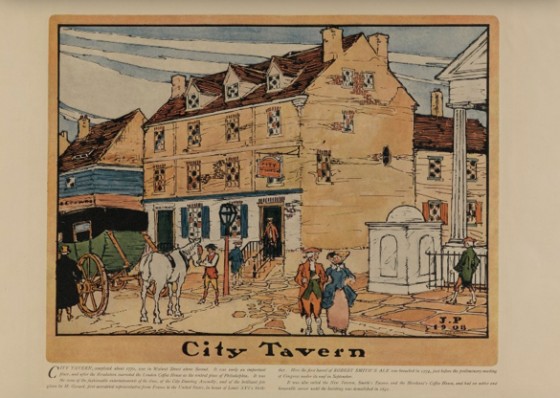
True to its name, Old City offers us a glimpse into a Philadelphia neighborhood in the days before independence. The history of some buildings, like The City Tavern, actually tell an even broader story about American history. Originally built in 1773 at 138 S. 2nd St., on the northwest corner of 2nd & Walnut, the City Tavern was a hotbed of intellectual discourse, political organization, and spirituous merrymaking. According to the Historical Society of Pennsylvania, the Tavern was a destination for the social elite, not just of Philadelphia, but of the collective colonies. It was visited by George Washington, Thomas Jefferson and Paul Revere and served as the unofficial meeting place for the First Continental Congress as war with the British approached. The sketch here below, drawn in 1908 and curated by the Historical Society of Pennsylvania, shows the Tavern as it would have appeared in the days of pre-Revolutionary fervor.
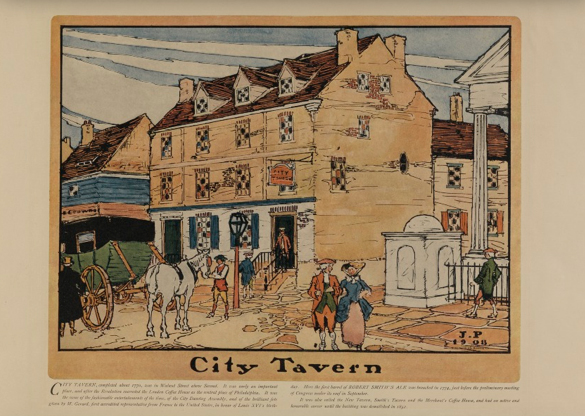
The City Tavern, deceptively tranquil on the cusp of war, 1770s
The Tavern would emerge unscathed from the struggle for independence and would continue to occupy a place of great importance in the young nation’s affairs. According to the Bean Exchange, the establishment came to be called the Merchants Coffee House, so-named because it was the site of the city’s stock exchange starting in 1790 as well as a fair amount of coffee drinking. The sketch below, also taken from the Bean Exchange, shows the Coffee House, presumably during trading hours.
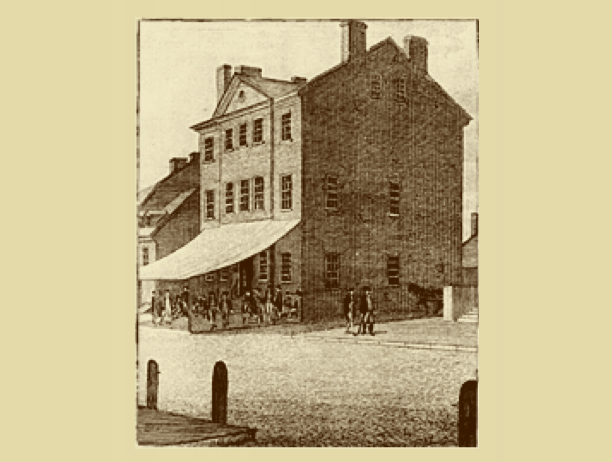
The Merchants Coffee House in the early 1800s
We can say with fair certainty that the sketch above depicts the building prior to 1834 because it was at this juncture that the Coffee House was consumed in a fire. That initiated a residency for the city’s traders in the landmark Merchant’s Exchange Building, which still stands around the corner on Dock Street. As for the Merchants Coffee House, it returned to its humble beginnings as a watering hole for the city’s wealthiest and most powerful men. It served in this capacity for the next 20 years but by 1854, was demolished to make way for retail space. According to Samuel L. Smedley’s Philadelphia Atlas, the site was occupied by something called the Liennig Building in 1862.
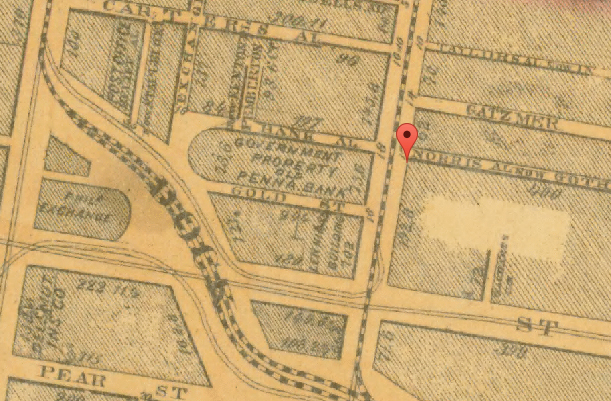
The Liennig Building, possibly leasing retail space, 1862
By the late 1800s, a booming immigrant population and seaport economy had transformed the neighborhood into a dense cluster of restaurants, taverns and inns catering to longshoremen and merchant traders. According to the book I.M. Pei and Society Hill: A 40th Anniversary Celebration, St. Alban’s Hotel, now at the City Tavern’s former address, ‘dominated the scene.’ An 1896 text entitled Philadelphia and Its Envirous tells that a stay at the St. Albans would run you between $1.00 and $2.00 per day, quite modest considering General Washington once ran up a $15,000 + dinner bill (adjusted for inflation) at the City Tavern. The hotel sign is visible in the foreground of this Library Company of Philadelphia from 1920, with Krider’s Gun Store shown directly across 2nd street facing eastward.
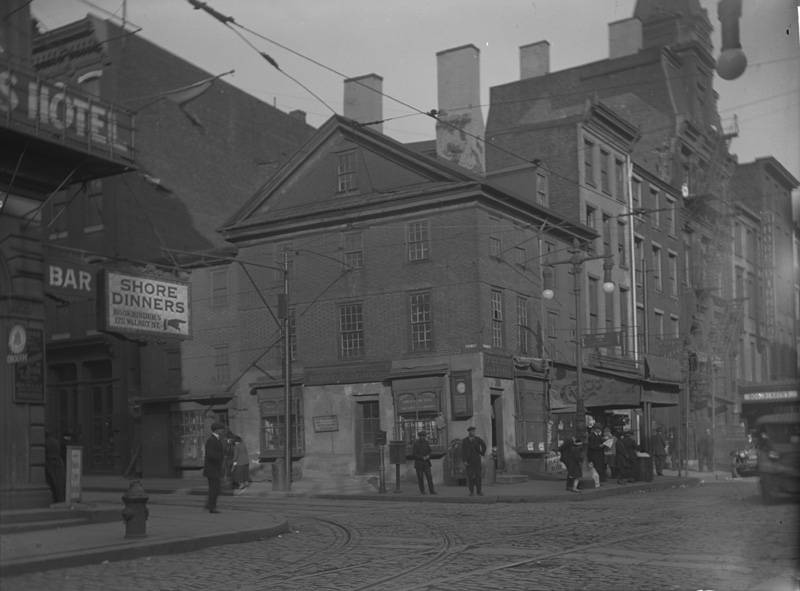
St. Alban’s Hotel ‘dominated the scene’ but is only partially visible here, 1920
By the mid-20th century, it appears that the building was owned by the city but not used for any specific purpose. According the Historical Society of Pennsylvania, in 1948 the city commissioned the reawakening of the old tavern. The faithfully reconstructed City Tavern is shown here below, in an image taken from the National Park Service’s charmingly outdated gallery of Philly tourism photos.
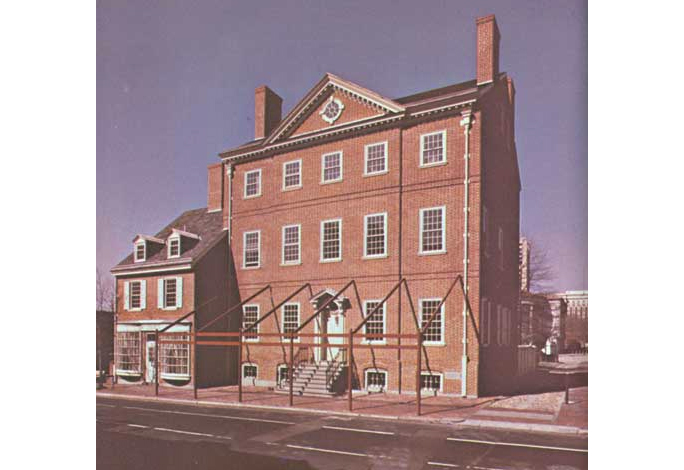
City Tavern via Instagram around the time of its reopening in the mid 1970s
The project for reconstruction would be complete a mere eighteen years after being commissioned, just in time for the Bicentennial celebration. The photos below, taken from the Philadelphia Department of Records, show the Tavern in 1976.
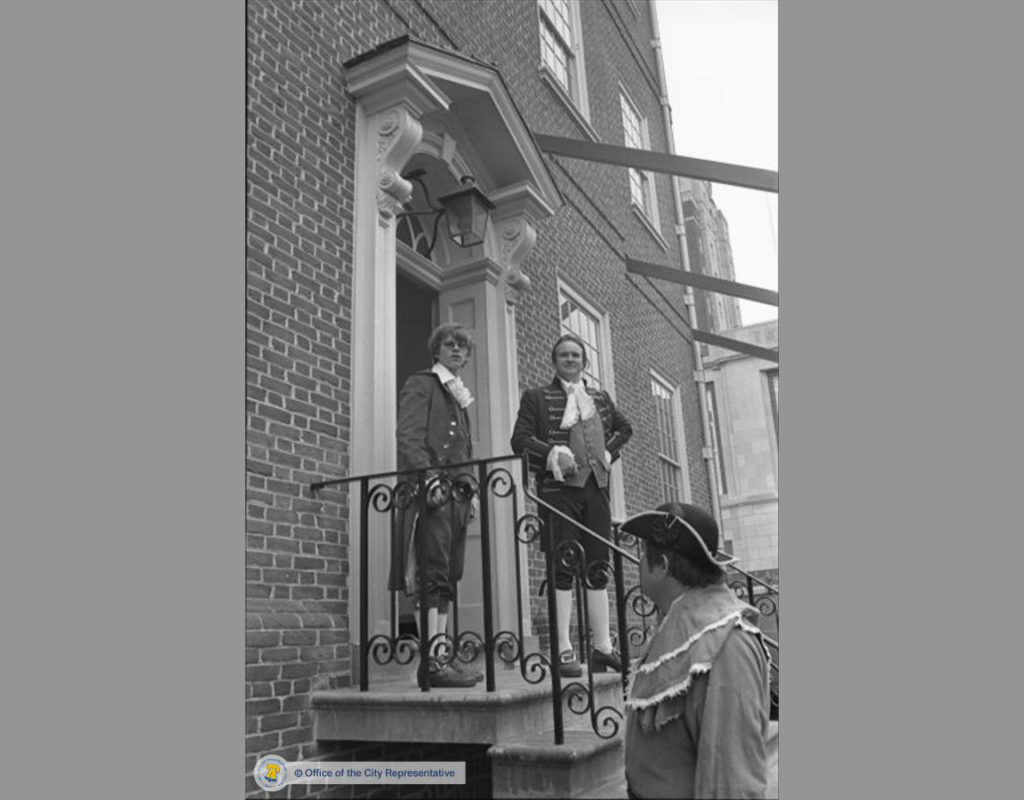
Historical re-enactors and sullen kid with bad summer job at reanimated City Tavern, 1976

Civic leaders drinking on the job, 1976. If you squint it looks like Ron Burgundy and his news team.
Since that time, the City Tavern has functioned as a popular tourist draw merging fine dining and authentically outfitted colonial history re-enactors.
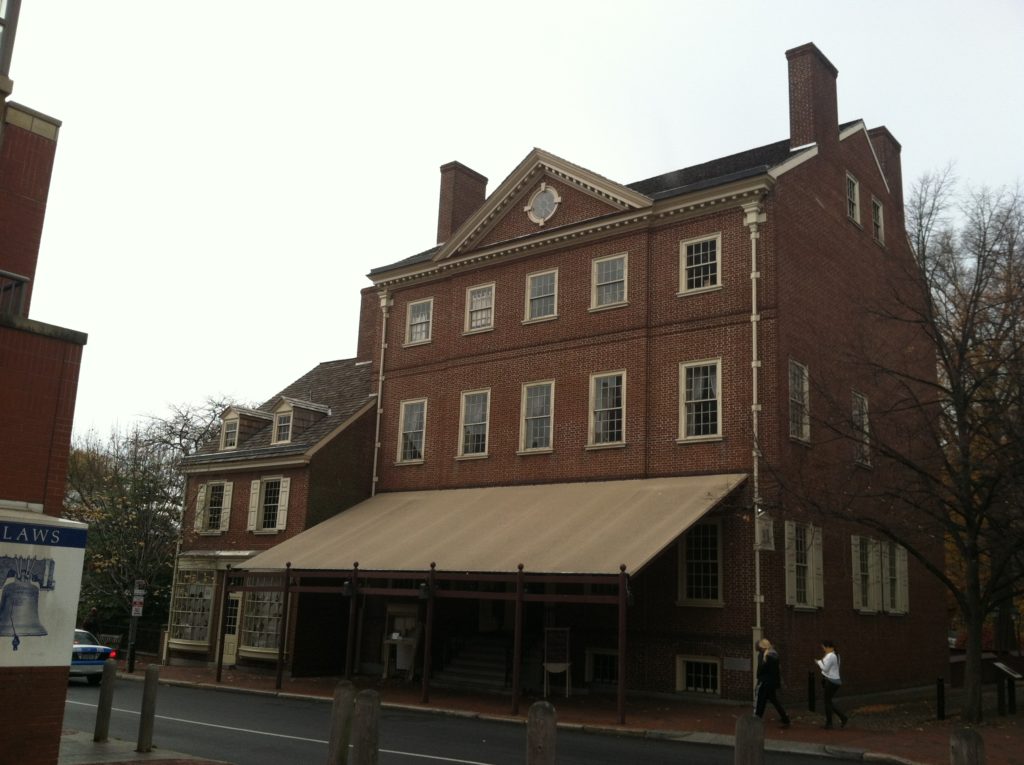
The City Tavern, Part Deux, 2013
–David Tomar
Leave a Reply